(Image source from: Moneycontrol.com)
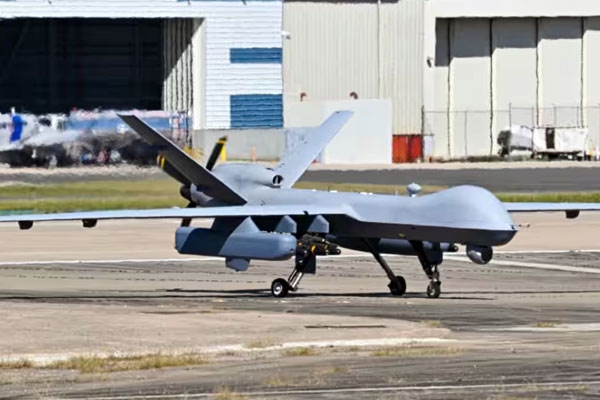
The United States military is experiencing substantial losses in its MQ-9 Reaper drones during Operation Epic Fury in Iran. These drones have played a crucial role in hitting many targets, such as military facilities and nuclear locations, but the losses are steep both financially and strategically. Reports suggest that between 11 and 13 MQ-9 Reaper drones have been lost in the ongoing conflict that intensified on February 28. Each drone costs around $30 million to $32 million, leading to a total projected loss for the Reaper fleet exceeding $330 million, according to the Wall Street Journal.
Initially created for counter-terrorism in areas with low risks, the Reapers, which have a top speed of 480 km/h, have shown to be very susceptible to Iran's sophisticated air defence systems.
On March 14, an MQ-9 was reportedly downed by the Islamic Revolutionary Guard Corps (IRGC) over Bandar Abbas in Hormozgan Province.
On March 15, an MQ-9 Reaper from the Italian Air Force was destroyed during an Iranian attack on the Ali Al Salem Air Base in Kuwait.
At least one Reaper drone was unintentionally shot down by Qatari forces in the early stages of the conflict. The MQ-9 Reaper is still the primary long-range, multi-purpose drone for the U. S. military. Made for both gathering intelligence and executing precise strikes, the Reaper has recently shifted from its usual counter-terrorism role to act more like a "missile truck" suited for advanced combat.
The Low-cost Uncrewed Combat Attack System (LUCAS) is a one-way "kamikaze" drone built to deliver an "affordable mass" in combat. This drone, shaped like a V, is directly inspired by Iran’s own Shahed-136. It was developed by a contractor from Phoenix called SpektreWorks, using technology from Iranian drones that were captured and reverse-engineered. It has an estimated range of 500 to 800 km and can hover over targets before exploding on impact. It is said to use SpaceX’s Starshield and Viasat for satellite communications, allowing for updates on targets during flight. LUCAS had its first combat deployment in early March 2026 during Operation Epic Fury, targeting sites in Iran alongside traditional manned aircraft and missiles.
Iran’s Shahed drones are a key part of its military strategy, offering a range from inexpensive "suicide" bombs to advanced high-altitude attack planes. These drones are made to produce "asymmetric mass," using numbers to overwhelm advanced air defences. A single Shahed-136 costs between $20,000 and $50,000, whereas the Patriot interceptors used to intercept them are about $4 million each. Iran reportedly launched over 1,000 drones targeting various locations across the Middle East, including the UAE and Jordan, significantly disrupting infrastructure and aviation. Recent analysis by Conflict Armament Research (CAR) indicates that Shahed warheads have been modified with metal pieces and specialized charges to increase damage against “soft" targets such as power grids.